
Bliss Villa has been operating for sixteen months, with occupancy that fills at peak season and holds through shoulder months with the consistency that comes not from marketing spend but from guests who return and tell people. Over sixteen months, the property delivered a 25 percent return on its original investment, a number that comes from operating records rather than projections. The villa is valued at $350,000 USD. The returns are quarterly. There are no surprises in the model because the model has already run.
This is not nothing. Most private villa investments in Southeast Asia spend their first two years finding their footing with operators, platforms, and local logistics. The fact that this one has already found it, and documented it, is material to anyone thinking about the next one.
The next property is named Mayari, after the Philippine goddess of the moon. It will be built on a comparable site in El Nido, designed with the same architecture-first approach that defines the current villa, and operated under the same management that delivered the existing results. LAPSOFLUX is presenting the investment opportunity exclusively.
Six investor positions are available at $20,000 USD each, representing 30 percent of the project collectively. The projected annual return is 26 percent, based on conservative and realistic occupancy modelling informed by the pilot’s performance. Distributions are quarterly. The full investment brief is available to interested parties on request..

MAYARI BY BLISS VILLAS · 6 Positions Available · $20,000 USD · El Nido, Palawan, Philippines
Minimum · 26% projected Annual Return · Quarterly Distributions · press@lapsoflux.com
Luxury travel is evolving, and Four Seasons understands that better than most. Onboard, a one to one guest to staff The existing villa will keep running. The light will keep coming on at dusk, the pool will keep glowing, and guests who found El Nido before it became a shorthand for a destination rather than an actual place will keep coming back because the villa is still specific enough to deserve a return trip.
That is what sixteen months proved.
The pool glows before anything else does. At dusk, when the last light has left the limestone karsts rising above Bacuit Bay and the palms have gone dark against the sky, the water at Bliss Villa holds its own illumination: a long rectangle of turquoise, flush with a hardwood deck, the villa rising behind it lit from within like a structure that was designed to be seen at this hour, from this angle, in exactly this quality of fading light. Which it was.
This is El Nido, on the northern tip of Palawan, a province the Philippine Tourism Authority has spent two decades trying to describe to the rest of the world without quite succeeding. The limestone formations are dramatic, but photographs make them generic. The sea is a specific shade of blue that cameras render faithfully and that still surprises visitors who thought they knew what to expect. The town itself is small, busy, recently overrun with the kind of tourism that always arrives slightly ahead of the infrastructure. Bliss Villa sits above most of that.
The villa is two storeys of white render and black-framed steel glass. From above, the geometry is almost formal: the pool runs through the centre of the private courtyard like an axis, flanked by teak decking and deliberate tropical planting, the gabled roof drawn in a herringbone bamboo lattice that catches warm light from recessed fittings below. Solar panels sit on the upper slope of the roof, visible from the air and not particularly hidden, which reads less as an oversight than as a statement of priorities. The overall impression is of a contemporary private home that has been thinking carefully about what kind of privacy it wants to offer.
The ground floor opens directly to the pool through floor-to-ceiling doors, the same black-framed steel that gives the facade its clean geometry, and that at night turns the interior into something between a greenhouse and a lantern. The staircase runs up through the centre, concrete-edged and unadorned. The bedrooms are upstairs. The pool is always in view.
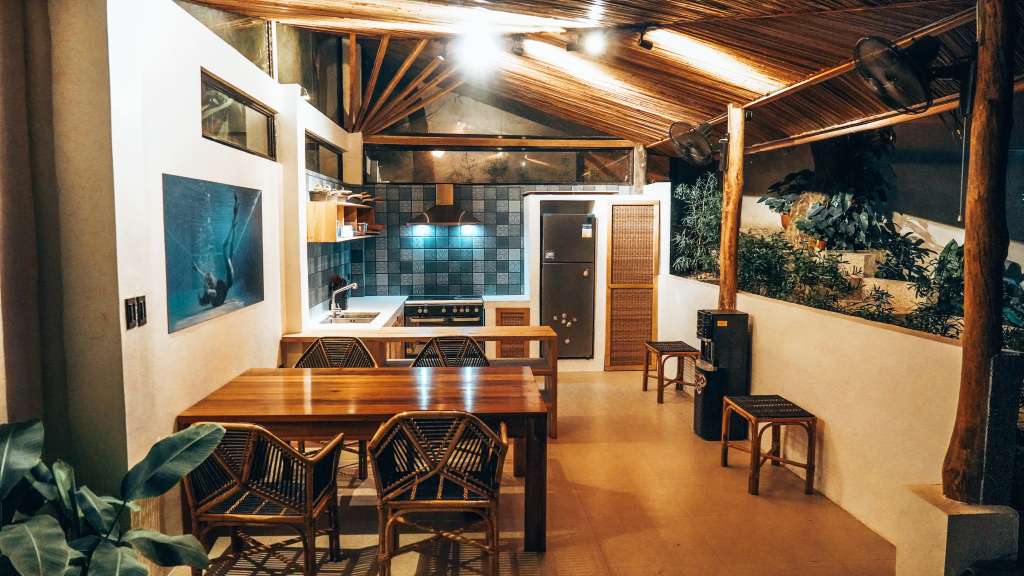
The living area is where the design makes its clearest argument. Slanted bamboo panelling lines the ceiling in close parallel strips, the kind of detail that requires both craft and patience to execute, and that changes the acoustic quality of the room in a way that is difficult to explain but immediately felt. The floors are polished concrete. The furniture is pale linen and woven rattan, positioned to face the doors to the pool, which are either open or seem like they should be. Large tropical plants occupy the corners without being decorative gestures. They look like they belong to the room and the room to them.
The bedrooms carry the same materials at a different pitch. The bamboo ceiling here is sculpted rather than flat, rising in a cathedral pattern toward the peak of the gable. An artwork over the bed depicts a sunset beach scene, silhouetted figures against an orange sky, and the palette of the room echoes it throughout: linen, earthy tan, rolled orange towels at the foot of the bed. This is the kind of detail that reveals itself on the second day, not the first.