
At a certain elevation, the light in the Alps does something that takes a moment to name. It arrives sideways in the early afternoon, catches the quartzite face of a building and turns it silver, then amber, then a kind of pale gold that has no real equivalent lower down. You notice it before you notice the building. Then you notice the building. It was only last Thursday (February 27, 2026) that guests could notice it for the first time at Rosewood’s newest address: Le Jardin Alpin, in the Jardin Alpin neighbourhood of Courchevel 1850, the French Alps’ most serious postcode for anyone who takes both skiing and spending seriously.
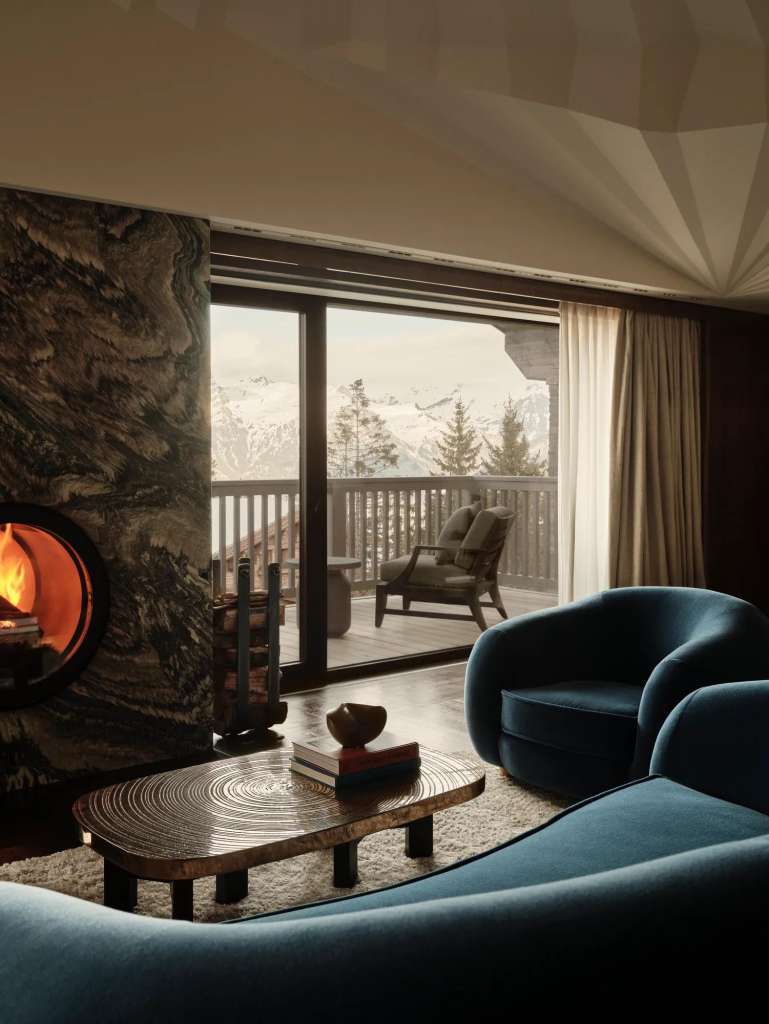
Rosewood Courchevel is the brand’s first ski resort. That distinction matters less than what the hotel actually does with it. The building is clad in Vals quartzite sourced from Switzerland and fitted with locally-made wood doors that age as the seasons move through them. Tristian Auer, the designer who led the project, has described the approach as creating a private mansion chalet rather than a traditional hotel. That phrase is either marketing or truth, and in this case it leans decisively toward truth.
There is a Courchevel that predates the crowds and the chalets marketed by footage of DJs at altitude. In the 1960s, when Brigitte Bardot made the village a destination for a particular kind of French glamour (winter holidays as fashion statement, mountains as backdrop for living well), Courchevel 1850 was a place people came to because they understood something about beauty and discretion. That era dissolved, eventually, into the louder version of itself that most visitors now encounter.
Rosewood’s arrival at Le Jardin Alpin is, among other things, an argument that the original instinct was correct. The hotel occupies a neighbourhood historically associated with private ownership rather than hotel commerce, which means the view from its 51 rooms and suites looks out onto a version of Courchevel that has not yet been organized for mass consumption. The approach, when it works, feels less like checking in and more like arriving somewhere that was waiting for you specifically.

We approached the project as though we were creating a private mansion chalet rather than a traditional hotel. The idea was to capture the glamour of the mountains while transporting guests into another world, a place where every space invites them to experience and discover something beyond the expected.”
Tristian Auer
The lobby contains crystalline installations by Olafur Eliasson, the Icelandic-Danish artist whose practice has long been concerned with the physics of perception: how light moves, how ice behaves, what water does to the eye at different scales. In the context of a ski resort lobby, this could read as decoration. It does not. The work catches the alpine light and refracts it in ways that change as the day moves, which means the lobby is different at nine in the morning than it is at four in the afternoon, and different again under evening lighting. The hotel, in this sense, continues working while you are in it.
Auer’s design, across the 51 rooms and suites, maintains a discipline that is harder to achieve than it appears. Each room is clad in wood and stone, with private terraces and mountain views as standards rather than upgrades. Some rooms include Himalayan salt block bars, an oddity that sounds like a wellness trend but reads, in person, as a genuine design decision about texture and material warmth. The cigar lounge was designed by Studio MTX, working within the Chanel Métiers d’Art tradition of craft. The detail level, throughout, is consistent.
The most interesting accommodation question at Le Jardin Alpin is not about the rooms: it is about the three private houses. Saluire House is a two-bedroom penthouse configuration with a copper art piece as its centrepiece, a fireplace, and the kind of ceiling height that makes a room feel like an argument about how much space a person actually needs. Courchevel House, also two-bedroom, is built around a bluestone fireplace and patinated brass fixtures that carry a different register, quieter and more considered. Both are intended for guests who have decided that a hotel room, regardless of its quality, is a category of accommodation they are no longer interested in.
Then there is the Jardin Alpin Apartment: four bedrooms, a private elevator, a cinema room, and a professional kitchen. At this level, the property is no longer a hotel stay in any meaningful sense. It is a residence with hotel services attached. Rates across the property begin at approximately €2,900 per night (around $3,400 USD). The private houses operate on a different calculus that Rosewood will discuss with you directly.
Direct ski-in, ski-out access to Les Trois Vallées (the largest connected ski area in the world) is not a selling point that requires elaboration for anyone who has spent time finding their skis after lunch at a resort that thought proximity to the slopes was sufficient. The cable car is there. It works. This matters more than almost anything else about the property’s location.
Salto, the hotel’s main restaurant, is led by Chef Gioia Baek and takes its reference points from the Italian Alps: fondue with a considered provenance, black truffle in the dishes where it belongs rather than where it impresses. The dining room is designed for the hour after skiing, when what a person wants is warmth and weight and something specific to eat rather than something to photograph. The wine list, one suspects, will do its job correctly. The Asaya spa follows Rosewood’s established wellness philosophy, with a post-mountain massage format (the Deep Alpine Massage, the Oxylight 3D Radiance Ceremony) and a swimming pool set beneath a glacier-inspired ceramic fresco that the designers clearly spent longer on than the photography will show.
Private ski instructors, curated mountain activities, and sunrise coffee on the peaks are available. These are services that exist at the intersection of hospitality and local knowledge, and they are either worth everything or nothing depending on who is providing them. The hotel’s answer, at this price point, is that they have chosen carefully.