
The Louis Vuitton trophy trunk was already on the Monaco podium before the name went on the gate. Since 2021, every Formula 1 Louis Vuitton Grand Prix de Monaco winner has received their trophy from a bespoke case hand-built at the Asnières-sur-Seine workshops outside Paris, the same workshops producing travel goods for Europe’s elite since the nineteenth century.
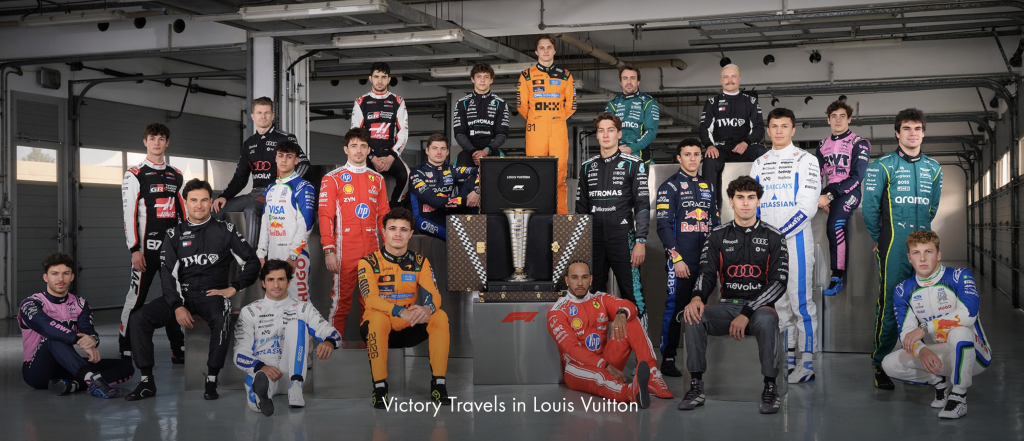
The naming rights announcement this year, made alongside the 83rd edition’s official poster, formalised what had already been visible to anyone paying attention. Vuitton had not bought its way in. It had been building a claim, quietly, for five years.

The race runs June 5 to 7. Seventy-eight laps. The circuit winds past Casino Square, down to the harbour, through the tunnel and back, unchanged for decades. This year, for the first time in its history, it carries a commercial partner’s name. The Automobile Club de Monaco confirmed the arrangement with LVMH, whose ten-year global Formula 1 deal, signed in 2024, identified Monaco as the centrepiece from the beginning.
Bernard Arnault’s presence at the 2025 Monaco Grand Prix was noted. The LVMH chairman does not appear at events without purpose. When the world’s largest luxury conglomerate commits to a ten-year global partnership and then puts Monaco at the top of the arrangement, it reflects a calculation, not sentiment.
Louis Vuitton succeeds TAG Heuer as Monaco’s title partner, another LVMH brand passing the baton within the same family. TAG Heuer’s association with Monaco runs deep: the square-cased Monaco chronograph, worn by Steve McQueen on his wrist in Le Mans in 1970, is among the most culturally loaded objects in watchmaking. That relationship now shifts registers. TAG Heuer remains an official timekeeper at the circuit. Vuitton takes the marquee. The conglomerate reorganises which brand it leads with. It loses nothing in the process.
The 83rd edition poster signals the shift visually. For the first time in Monaco Grand Prix history, the artwork foregrounds the start-finish straight and the podium itself, not the cars, not the streets. Racing image as trophy image. Monaco is now as much about the moment of victory as the contest that produces it.
Each Monaco trophy trunk is crafted in Asnières, finished in the house’s monogram canvas accented in red, Monaco’s national colour. A stylised V, for Vuitton and Victory, completes the design. It appears on the podium, in the press conference, in every photograph that circulates for the week that follows. Six consecutive years. Zero paid media required.
This is the most effective brand placement in professional sport: an object that is both functional and photographed, that belongs to the ceremony rather than decorating it. The production cost is negligible against any conventional media budget. The exposure is structurally guaranteed. Every time a driver lifts a Monaco trophy, a Vuitton trunk is in frame. The house did not need title sponsorship to make an impression. Title sponsorship is the next chapter after the trunk had already done its work.
Charles Leclerc launched a capsule collection with Ferrari ahead of his home race. Tailored separates in Rosso Corsa and carbon black, cut for moving between the paddock and a restaurant terrace without changing. A bomber jacket carries the Scuderia shield reduced to a tone-on-tone emboss. Leclerc, born eleven minutes from the pit lane, understands something about Monaco that visiting drivers have to learn: the circuit is a stage before it is a track, and what you wear to it is part of the performance.
Lewis Hamilton’s influence on this shift is worth acknowledging. When he moved to Ferrari this season, he brought with him the wardrobe culture he had spent years building. His custom Dior look at last year’s Monaco generated more coverage than qualifying. Drivers who once defaulted to team polo shirts now employ stylists. Max Verstappen showed up in Loewe. Lando Norris wore Prada. The transformation happened across three seasons. It will not reverse.
The women in the paddock have always dressed well. What changed is the audience. Alexandra Saint Mleux, George Russell’s partner, commands a social following larger than most fashion editors, and her Monaco outfits trend within minutes of publication. The harbour has become, functionally, a street style event with higher stakes and a better backdrop.
AG Heuer hosted from Le Bougainville, a yacht anchored in the Port of Monaco, mixing racing figures with actors, models, and brand ambassadors. Patrick Dempsey, who races vintage cars himself, co-hosted. The guest list read like a casting brief for a luxury campaign: international enough to travel, cultured enough to hold a conversation about horology. Monaco’s hospitality now operates at the same pitch as Wimbledon or the Oscars, with the difference that the backdrop moves at 300 kilometres per hour.
Formula 1 delivers 1.5 billion cumulative television viewers per season. Its audience skews younger and wealthier than traditional luxury advertising channels, and it is growing. When LVMH calculated its ten-year investment, those numbers were the foundation. Monaco is the most concentrated expression of what the sport has become: wealth, visibility, and performance compressed into 3.337 kilometres of street circuit.
The integration of luxury into Monaco is not new. The harbour yachts have been chartered by brand hospitality teams for fifteen years. The paddock has been a fashion front row for at least five. What is new is the formal naming, the official poster foregrounding the ceremony rather than the sport, the deliberate repositioning of a race as a luxury event that also happens to determine a championship. Some people who have watched Monaco for decades find that uncomfortable, and not without reason. The race’s mythology was built on difficulty, on the impossibility of overtaking, on the physical violence of threading a modern car through streets that were never designed for it. The question worth sitting with is whether the monogram canvas and the title sponsorship change what Monaco actually is, or simply clarify what it had been quietly becoming for some time.
The circuit has not been altered. The cars will still go through the tunnel at 270 kilometres per hour. Whoever wins will stand on a podium and receive a trophy from a bespoke Vuitton trunk, just as they did last year and the year before. The only difference is that now it says so on the sign.
Instagram: @lapsoflux @louisvuitton @scuderiaferrari @charles_leclerc @lewishamilton @tagheuer @f1
Hashtags: #MonacoGP #LouisVuitton #LVMH #FormulaOneLouisVuittonGrandPrixdeMonaco #F1Monaco #MonacoGrandPrix2026 #F1Fashion #PaddockStyle #LAPSOFLUX