
At Monza, Ferrari never arrives alone. The grandstands bring the flags, the old victories arrive as muscle memory, and every red car carries a century’s worth of expectation into the braking zone. This year, the Scuderia has added another presence to the grid: Michael Schumacher’s.
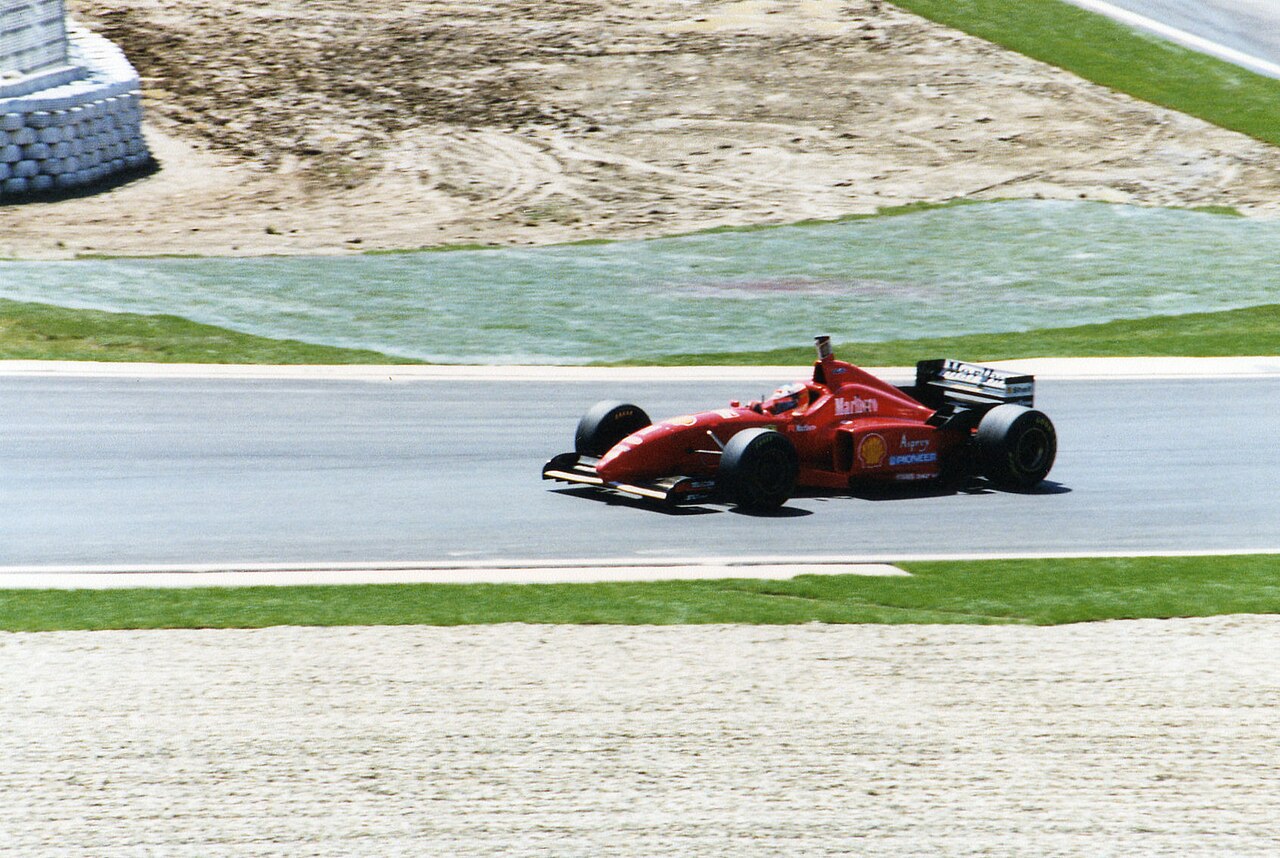
For the 2026 Italian Grand Prix, Ferrari has transformed its SF-26 into a moving tribute to the season that began the most consequential partnership in modern Formula One. Thirty years after Schumacher joined Maranello in 1996, the team has returned to the visual language of his first Ferrari, the F310—red, white and black, unapologetically graphic, and instantly readable at speed.
A livery with a memory
Special liveries can be little more than expensive wrapping paper. This one works because its references are precise. White sections echo the F310’s bodywork. Black elements sharpen the car’s silhouette. Seven stars and Schumacher’s “MS” mark acknowledge the seven world championships that made his name inseparable from the era, five of them won with Ferrari.
The tribute also marks 20 years since Schumacher’s final season with the team. That symmetry gives the design emotional weight: 1996 was the uncertain beginning, when Ferrari was famous but fragile; 2006 was the end of a decade in which the organization had become the standard every rival chased.
Schumacher won five times at Monza in Ferrari red—in 1996, 1998, 2000, 2003 and 2006. The first of those victories mattered beyond the points. It was Ferrari’s first Italian Grand Prix win since 1988, and it offered the tifosi an early glimpse of the future being assembled around their new driver.

Ferrari is selling continuity, not nostalgia
The strongest luxury houses understand that heritage is not a museum label. It is a living material. Ferrari’s advantage is that its archive can still move, make noise and compete. A watchmaker can reissue a dial and a fashion house can revive a silhouette; Ferrari can send a memory down the Monza straight at more than 300 kilometres per hour.
That is why the weekend extends beyond paint. Ferrari is exhibiting the F310, the championship-winning F2002 and the 248 F1 from 2006. The F2002 is also scheduled to return to the circuit with two drivers who understand the Schumacher years from different angles: Rubens Barrichello, his teammate during Ferrari’s dominant run, and Sebastian Vettel, the German champion who later inherited much of the same national expectation.
The result is closer to a living archive than a conventional anniversary display. These machines are not treated as silent objects. They are evidence of an operating culture: ruthless preparation, technical clarity and the ability to turn individual talent into institutional momentum.
Why this matters now
Formula One has become a global entertainment platform, but Monza remains resistant to becoming generic. The circuit is fast, old and emotionally partisan. Ferrari’s choice to foreground Schumacher is a reminder that modern reach still depends on specific stories rooted in specific places.
It also reveals something about contemporary luxury. The most valuable brands are no longer simply protecting their history; they are staging it. The audience wants access to the archive, but it wants that archive activated. A vintage car behind a rope creates distance. A vintage influence racing in front of a grandstand creates participation.
Ferrari has become especially adept at translating motorsport history into a broader cultural language. The Scuderia’s clothing, road cars, collectibles and hospitality all benefit when racing heritage feels immediate rather than academic. Schumacher’s decade supplies an unusually powerful chapter because it contains both struggle and domination. He did not join a finished dynasty. He helped build one.
The red thread
There is an easy temptation to read the tribute as a backward glance, especially at a team whose past success can make every current season feel like an examination. But Ferrari’s best interpretation is more ambitious. The livery says that reinvention and continuity are not opposites. The 1996 F310 was awkward, imperfect and historically essential. It was the first draft of the machine Ferrari would become.
At Monza, the SF-26 carries that first draft on its skin. The names have changed, the technology has become nearly unrecognizable, and the commercial scale of Formula One has expanded beyond anything the paddock of 1996 could have imagined. Yet the central idea survives: Ferrari is most compelling when the car is not merely red, but connected to a story worth carrying forward.
There is another reason the tribute resonates: Schumacher’s Ferrari story was never only about winning. It was about building the conditions for sustained excellence—assembling the right engineers, demanding repetition and turning pressure into a shared discipline. That culture remains the real artifact Ferrari is trying to keep alive.
For one weekend, Schumacher’s Ferrari is not frozen in the past. It is back where the tifosi always believed it belonged—in motion.