A handbag can introduce you to a fashion house. A table can give you a reason to stay. That is the appeal of the brand café: an environment where a label’s taste becomes something you can encounter through a chair, a cup, a plate and the pace of an afternoon.
For a visitor, the invitation is easy to understand. Meet a friend. Order something. Look around. A familiar social ritual becomes the entry point into a carefully designed world. Fashion gains another way to express itself, while the guest receives an experience with a purpose beyond browsing a collection.
Three examples show how differently that proposition can work. Prada’s former Harrods café translated a visual identity into a London interior. Louis Vuitton’s Paris café connects culinary craft with the house’s motifs. Dior places gastronomy inside its historic address. Their interest lies in the details of that translation.
Archive: Prada Caffè at Harrods, 2023–2026. Image source: Prada.
Prada: A Visual Language You Could Sit Inside
Prada’s official archive dates its Harrods café to March 2023–June 2026. It is a completed project rather than a current London dining recommendation. The interiors used the house’s familiar green across walls, ceilings and upholstered seating, while the chequered floor recalled its historic Milan boutique. Exclusive tableware extended the design to the table itself.
Those decisions made the space recognisable without requiring every surface to carry a name. Colour, geometry and material did the work. A visitor could experience the visual connections simply by sitting down and noticing what surrounded them.
That offers a useful distinction for anyone designing a brand environment. Recognition can come from the way a room feels and functions. Repeating a logo creates visibility; translating a coherent design language creates something people can explore.
The café’s finite run matters, too. Temporary hospitality should be judged as a project with a beginning and an end. Its images may continue circulating long after its last service. Anyone planning a visit needs current information, rather than a beautiful photograph detached from its date.
Archive: Prada Caffè at Harrods, 2023–2026. Image source: Prada.
Archive: Prada Caffè at Harrods, 2023–2026. Image source: Prada.
Louis Vuitton: Craft Moves to the Table
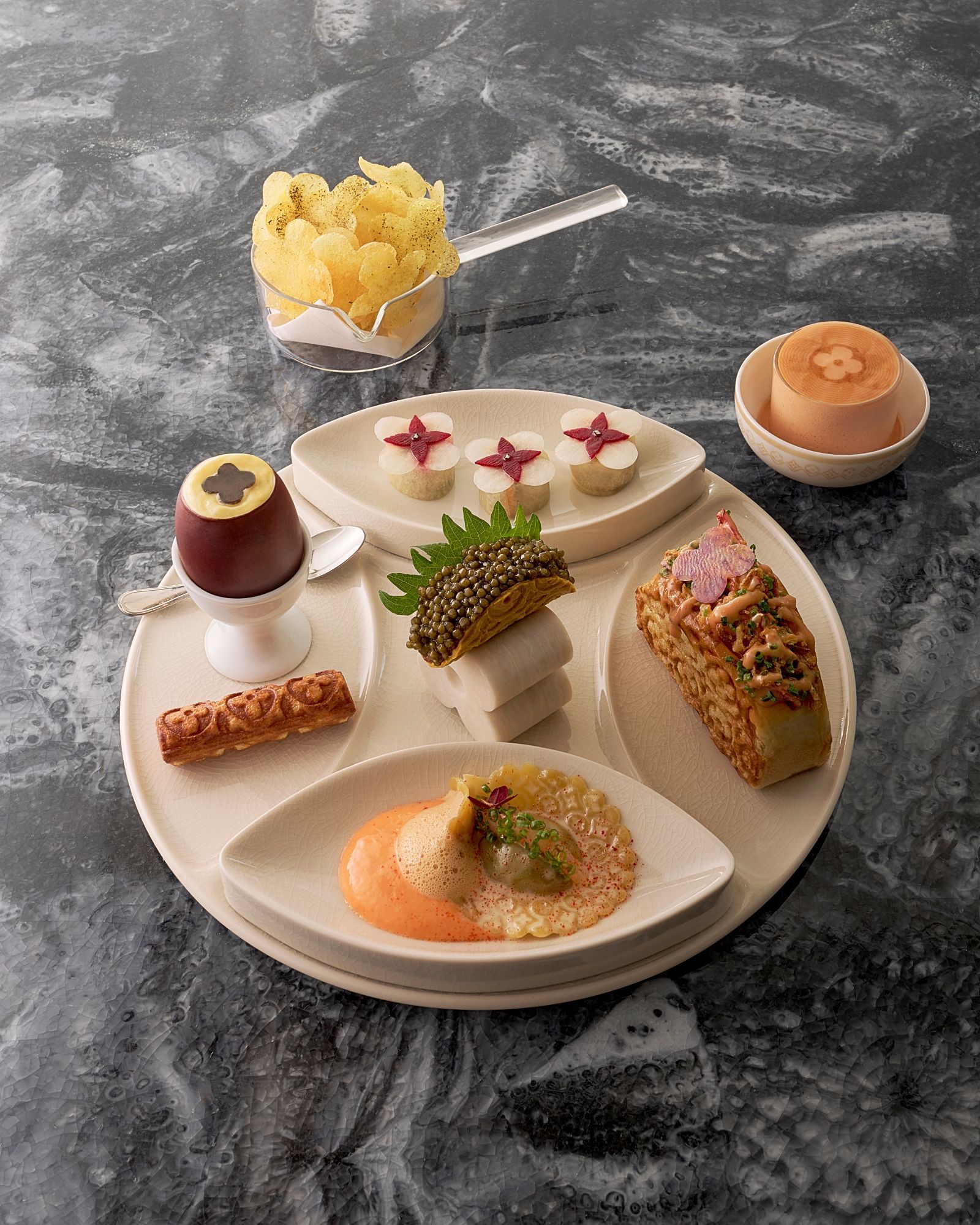
In Paris, Maxime Frédéric at Louis Vuitton occupies an address on rue du Pont Neuf overlooking the Seine. The house describes a café offering savoury dishes, pastries and chocolates, with graphic creations that echo its visual motifs. Its official page provides separate details for lunch, tea time and pastries.
Here, the connection becomes particularly clear through the relationship between form and food. A recognisable pattern can be interpreted through chocolate or pastry, giving a guest another way to encounter the design. The result has to work as something to eat as well as something to photograph.
That practical requirement is what makes hospitality demanding. A room can establish an expectation within seconds, but the meal and service have to sustain it. Temperature, timing, comfort and communication become part of the brand experience, even though they rarely appear in a campaign image.
For visitors, this also creates a different reason to approach a house. Someone interested in pastry may arrive through the chef’s work. Someone interested in interiors may arrive through the setting. Both can discover aspects of the wider brand through an experience they already understand.
Image source: Louis Vuitton.
Image source: Louis Vuitton.
Dior: Hospitality at a Historic Address
Dior’s 30 Montaigne brings the idea into the townhouse associated with the house’s founding in 1946 and its historic ateliers. The official restaurant page identifies Yannick Alléno as the chef directing Monsieur Dior, Le Jardin and the Café. It describes a culinary approach informed by nature, flowers, archives and couture.
The address gives those references context. A dish inspired by flowers participates in a broader story about the founder’s interests and the house’s creative vocabulary. Architecture, heritage and the menu can reinforce one another because they belong to the same setting.
It is also a reminder that a successful concept needs specificity. A fashion house should have an answer to why its restaurant belongs to that particular house. An identifiable point of view can shape the food, the room and the welcome, giving the experience a consistency that decoration alone cannot supply.
Dior’s example invites a useful question for guests: what can you discover here that you could not discover in another attractive dining room? The answer should emerge in the details, from the references behind the menu to the way the surroundings frame a visit.
These examples demonstrate different ways to build a destination. They do not, by themselves, establish that a café increases fashion sales. That would require commercial evidence, with enough context to distinguish the hospitality operation from the performance of the wider business.
The more immediate editorial question is whether the experience makes sense on its own terms. Would you enjoy the room? Is the offering clear? Does the service support the promise? Can someone understand the connection to the house without needing a lengthy explanation?
For fashion brands, hospitality makes identity tangible in an unusually personal way. You spend time with it. You touch the tableware, notice the light and remember who sat opposite you. The impression forms through a sequence of small encounters.
That is what makes the café concept worth watching. It takes a world often experienced through images and gives it an address, a rhythm and a place in somebody’s day. The strongest expression is one you would want to return to after the first photograph.